




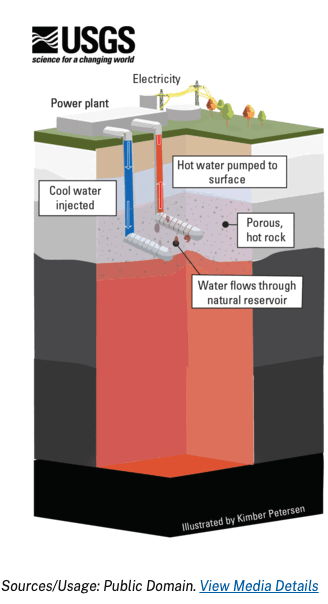
Traditional Geothermal Power Plant
Historically, geothermal power plants have been developed around natural hydrothermal systems, which rely upon three elements: (1) a concentration of heat near the surface of the Earth’s crust; (2) permeable rock; and (3) water flow. These systems are dependent on finding the right location, the size, and temperature of the resource. If the resource isn’t big enough and hot enough, the power plant may not be economical or long-lasting. And, despite everything we know about the Earth’s crust, identifying the exact location of productive thermal resources can be time-intensive and expensive. However, the potential for geothermal energy in the U.S. is enormous if it can be developed economically. Recently, there have been parallel efforts both to develop ways to take advantage of the heat of the crust where there isn’t permeable rock and water flow; and exploration advances to better identify productive geothermal locations.
Understanding Enhanced Geothermal Systems
Enhanced Geothermal Systems[1] (EGS) use hydraulic fracturing to engineer a subsurface fracture network to allow circulation of water through hot crust. With this kind of fracturing, if the rock is suitably hot, a power plant can inject cool water into the hot crust, allow it to flow through the engineered fracture network and then come back to the surface as hot water, which can turn a turbine and generate electricity. The engineering skills for this process are mostly derived from the oil and gas industry and research and development of these techniques has been accelerating, especially in Utah and the Great Basin region.
[1] Horne, Roland, et al. “Enhanced geothermal systems for clean firm energy generation.” Nature Reviews Clean Technology 1 (2025). https://doi.org/10.1038/s44359-024-00019-9.



 We would like to clarify that Utah Clean Energy is not a solar company. We are a nonprofit organization that advocates for solar and other clean energy technologies, but we do not install or sell solar in any way.