




The proposed Stratos data center project in Box Elder County is a massive project that will have a significant impact on Utah’s air quality and water resources. If it is built out to full capacity, it will consume twice as much electricity as the entire state consumes annually during peak usage, and will increase our state’s climate emissions by 55%-75% depending on the type of gas generation. Given the scale of this project, Utah policymakers and the public deserve to understand exactly what these impacts are before construction begins or similar projects are contemplated.
Using the limited public information currently available, Utah Clean Energy has provided a breakdown of the likely impacts to our community.
Utah Clean Energy’s Position
“We are proud to live and work in a state that values responsible stewardship of our air, water, and land while fostering innovation in energy and technology. As electricity demand for data centers grows, developers and state leaders have a ripe opportunity to champion projects that rely on Utah’s abundant clean energy resources, while also minimizing water consumption and adverse impacts on our air quality. We believe Utahns deserve more information and facts about this proposed project to fully understand its impacts on our health, well-being, and resources,” states Sara Baldwin-Griffin, Utah Clean Energy CEO.
Powering the Stratos Data Center
This project is proposing to use 9 gigawatts (GW) of electricity generated entirely from on-site gas power plants to power its operations. This amount of electricity is unprecedented and would nearly double the entire state of Utah’s electricity 2025 peak demand. The gas fired power plants are also likely to produce a significant amount of air pollutants and greenhouse gas emissions and entail significant water consumption.
Given the minimal publicly available information about the Stratos project, we assume that the natural gas power generation for this facility will use either combined-cycle combustion turbines (CCCT) or reciprocating internal combustion engines (RICE). Both types of gas generation technologies have different costs, availability, water use, and emissions profiles (see below). These impacts are only for the power generation and do not include other impacts of running the data center itself, such as water needs for cooling, or upstream leakage of methane from natural gas infrastructure.
According to Utah Clean Energy’s initial analysis:
If the 9 GW of power is generated with a combined-cycle combustion turbine (CCCT), we estimate that the project will have the following impacts and costs:
- Consume about 448 billion cubic feet of gas per year.
- Based on 2023 data, this is roughly 1.5 times more natural gas than the entire state of Utah currently uses across all homes, businesses, and existing power plants combined. Compared strictly to the gas sold to Utah homes, the power plant for this data center would use about 5 times more gas.
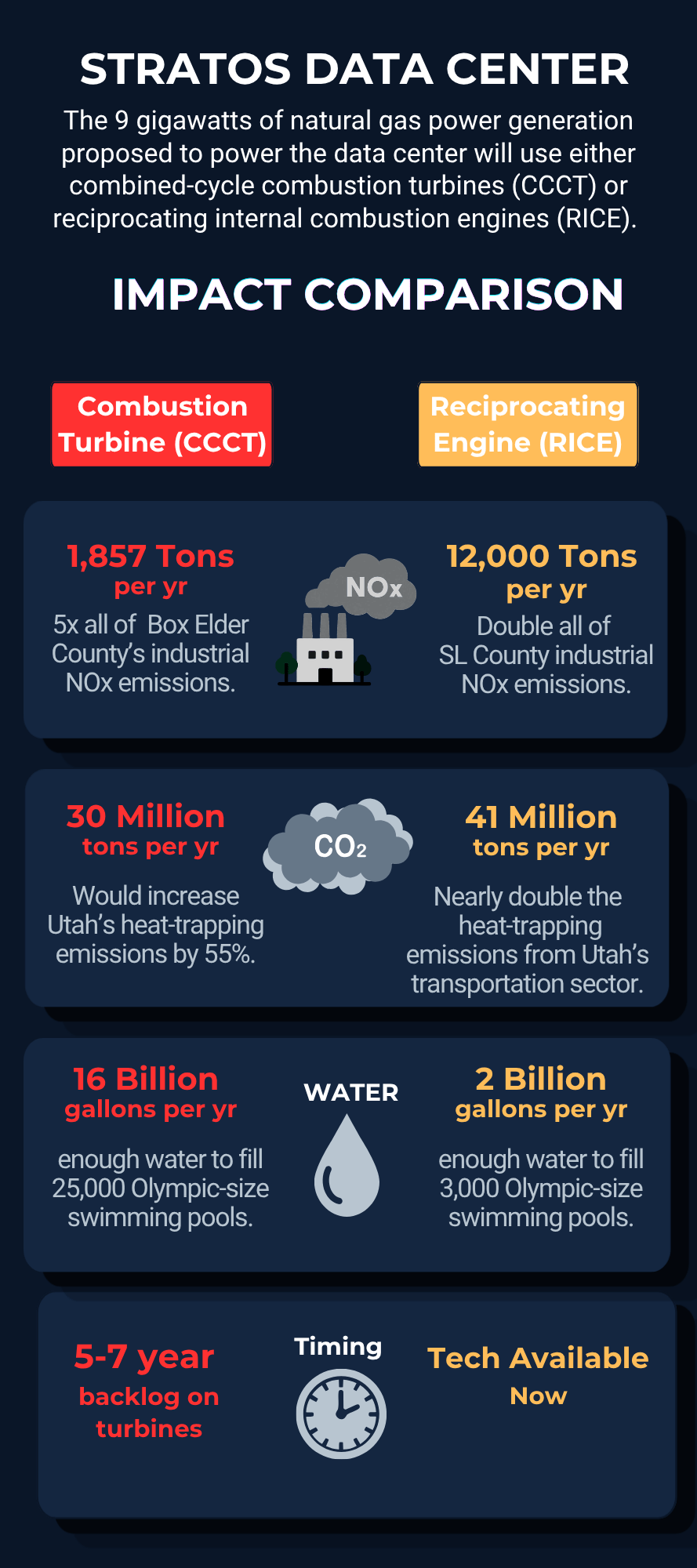
- Produce 1,857 tons of NOx/year.[i]
- This is ~5 times more than the entirety of Box Elder County’s industrial emissions of NOx (2020).2,3
- Produce 30.2 million tons of CO2/year.2
- This would increase Utah’s CO2 emissions by 55%.
- Use 16.6 billion gallons of water/year to operate the gas turbines.4
- This amount of annual water use would fill approximately 25,000 Olympic-size swimming pools.
- The levelized cost of energy of a combined-cycle customer turbine facility is ~$100/MWh.6
- For comparison, this is on par with the cost of utility scale solar and storage.
- These turbines are not available for 5-7 years.
If the 9 GW of power is generated with a reciprocating internal combustion engine (RICE), we estimate that the project will have the following impacts and costs:
- Produce 12,000 tons of NOx/year.
- This is approximately double the entire Salt Lake County industrial emissions of NOx, or equivalent to the annual NOx emissions from Utah’s entire oil/gas industry (2020).2,3
- Produce 41 million tons of CO2/year.2
- This would increase Utah’s CO2 emissions by 75%. It would be nearly double the emissions from the Transportation sector (19.5 MMT/yr) or the Electric Power sector (20.9 MMT/yr).
- Use 2 billion gallons of water/year to operate the reciprocating gas engines.4
- This amount of annual water use would fill approximately 3,000 Olympic-size swimming pools.
- The levelized cost of energy for a gas reciprocating engine facility is ~ $120/MWh.6
- This is much more than the cost of utility scale solar and storage.
- These reciprocating engines are available now.
The Stratos Project will likely need additional environmental review before the project can commence construction, including for air quality permits, as Box Elder County officials discussed at the recent public hearing. We will update our analysis as more information becomes available.
References and background information:
- U.S. EPA Clean Air Markets Program Data: https://campd.epa.gov/data/custom-data-download
- We reviewed the information about expected emissions from reciprocating gas engine units being used for the Joule Capital Partners data center being constructed in Millard County. We units per unit emissions from this facility and scaled them up for the proposed Stratos Project given its 9 gigawatt total size. Approval Order: New Natural Gas Power Facility approving a new natural gas facility: https://daqpermitting.utah.gov/DocViewer?IntDocID=160548&contentType=application/pdf
- Utah DAQ’s triannual emissions inventory (2020): https://deq.utah.gov/air-quality/2020statewide-emissions-inventories
- PacifiCorp 2025 IRP, Table 7.4: https://www.pacificorp.com/content/dam/pcorp/documents/en/pacificorp/energy/integrated-resource-plan/2025-irp/2025_IRP_Vol_1.pdf
- Kem. C. Gardner Policy Institute Research Brief, Utah’s 2025 Energy Landscape and Outlook for 2026 and Beyond: https://d36oiwf74r1rap.cloudfront.net/wp-content/uploads/2026/04/ERG2026-Energy-RB-Apr2026.pdf
- Energy cost estimates from the Lazard LCOE+ (Levelized Cost of Energy) Report, June 2025 https://www.lazard.com/research-insights/levelized-cost-of-energyplus-lcoeplus/ and EIA https://www.eia.gov/outlooks/aeo/electricity_generation/pdf/AEO2025_LCOE_report.pdf
- 2026 Great Salt Lake Data and Insights Summary, Kem C. Gardner Policy Institute: https://d36oiwf74r1rap.cloudfront.net/wp-content/uploads/2026/03/GSL-Summary-Mar2026.pdf
[i] One of the primary pollutants resulting from natural gas combustion is a class of pollutants known as nitrogen oxides (NOx), which are precursors for both harmful smog (ozone) and soot (particulate matter) pollution. Ground-level ozone and particulate matter are linked to cardiovascular illnesses, respiratory problems, and premature death, both in the short term and over a longer exposure period. (Sources: https://turbinemap.edf.org and https://www.lung.org/research/sota/health-risks)






 We would like to clarify that Utah Clean Energy is not a solar company. We are a nonprofit organization that advocates for solar and other clean energy technologies, but we do not install or sell solar in any way.