




Geothermal Primer Part 2: Geothermal as a Distributed Resource
Geothermal: geo = earth + thermal = heat
In our Geothermal Primer Part 1, we looked at how geothermal energy can provide electricity on a utility-sized scale. Now, in Part 2, we’ll shift gears to explore how the heat of the earth can be used closer to home, a.k.a. as a distributed resource. This can take two forms: using geothermal heat directly, or tapping into it as part of a ground source heat pump (GSHP) for heating and cooling.
50 Degrees All Year: A Smarter Way to Heat and Cool Your Home
While the earth gets very hot as you go deep into the crust, the story near the surface is quite different. The temperature in the top 5 feet varies with the local weather – hotter in the summer and colder in the winter. But once you go down a short distance, around 10 to 30 feet, the earth’s temperature is constant, and fairly moderate year-round. In Utah, the earth’s shallow temperature is approximately 50°F year-round, an ideal, mild temperature for heating and cooling. Instead of working against extreme outdoor temperatures, an HVAC compressor can work from this stable ground temperature as a baseline, only heating from 50°F to 70°F in the winter, or using the mild 50°F temperature to cool a house down in the summer. The result? Less work for your system and a lower energy bill.
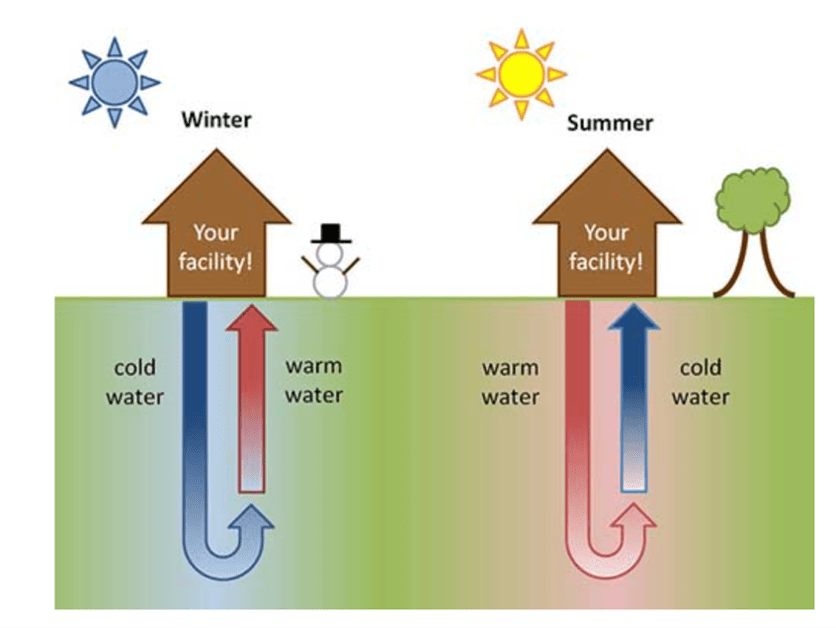
Image credit: https://soundgt.com/about-soundgt/
How do Ground Source Heat Pumps work?
Heat pumps use a compressor to raise or lower the temperature of a working fluid. For air source heat pumps (ASHP), the working fluid is the air, and the heat pump takes the heat in the air and either warms it in the winter or cools it in the summer. But keep in mind, air temperatures vary widely, which makes air source heat pumps less efficient in places with extreme temperatures like Utah. For a ground source heat pump (GSHP), the working fluid is generally water, brine or antifreeze. Here is the basic idea:
- Pipes buried in the ground are filled with water, brine, or antifreeze.
- The fluid absorbs heat or cold from the buildings and circulates it underground where temperatures are constant.
- In winter, the fluid absorbs heat from the ground, providing heat. In summer, the fluid releases heat into the ground.
- The fluid then circulates back up to the building to heat or cool as needed.
This process is about twice as efficient as Air Source Heat Pumps at the coldest time of the year because the moderate temperatures of the earth. The warm fluid circulating through geothermal boreholes can also be used to heat water or as radiant floor heating.
What’s The Catch?
The catch with Ground Source Heat Pumps, and geothermal energy in general, is that you have to drill holes. You don’t actually have to go very deep, but you need the working fluid to be in contact with the earth for long enough to effectively transfer heat. For this reason, a typical system uses either horizontal or vertical wells with pipes that snake through the ground over a great enough distance for the heat exchange to occur. Horizontal wells are easier to dig but take up more area. Vertical wells require more drilling but have a smaller footprint.
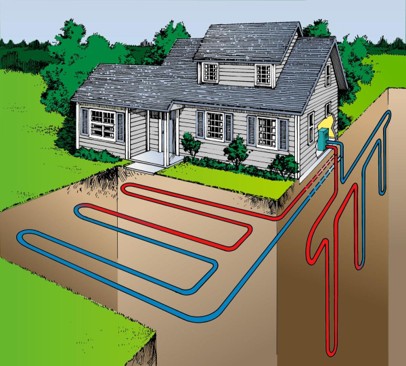
Image credit: https://discover.hubpages.com/technology/Using-A-Geothermal-Heat-Pump-Geoexchange-For-Heating-and-Cooling
Geothermal Can Power Entire Neighborhoods or Campuses
While heating and cooling a home or buildings is the most basic application for on-site geothermal, it can also be networked for neighborhoods, campuses, or businesses to meet a variety of needs efficiently.
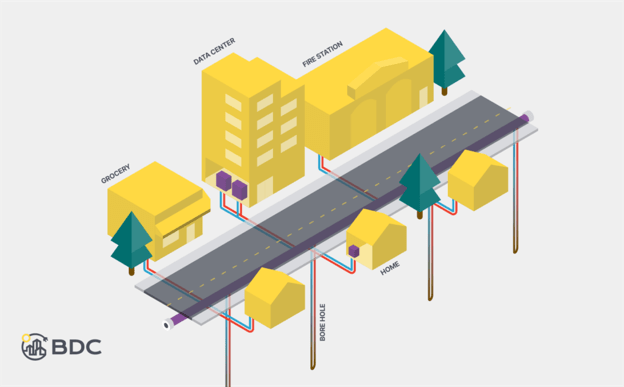
Image credit: https://buildingdecarb.org/resource-library/tens-faq
Colorado Mesa University (CMU) in Grand Junction, Colorado, is a great example of how a networked geothermal system is providing benefits to 11,000 students across 141 acres. CMU embarked on this project in 2008 and it has grown to encompass a majority of the campus heating and cooling needs while saving more than $15 million in energy costs.
This system is designed to make the most of energy that would normally be wasted. When one building needs cooling, the networked system sends excess heat from that building to a building looking for heat. This is one example of where something like a college campus shines. Different buildings have different needs; dorms that require more heating, and academic buildings which require more cooling, for example.
“Geo-exchange technology is an important part of CMU’s sustainability efforts. To expand its energy saving potential, CMU embarked on a true engineering marvel where the system is interlocked with the campus’s Olympic-sized swimming pool, irrigation system and domestic water needs using these sources as a heatsink.”
The local utility, Xcel Energy, completed an evaluation of this networked geothermal system in 2023. They found that, over the course of a year, the networked geothermal system reduced electricity demand by 13%, reduced electricity usage by 10%, provided natural gas savings of 55%, and water savings of about 10 million gallons, annually.
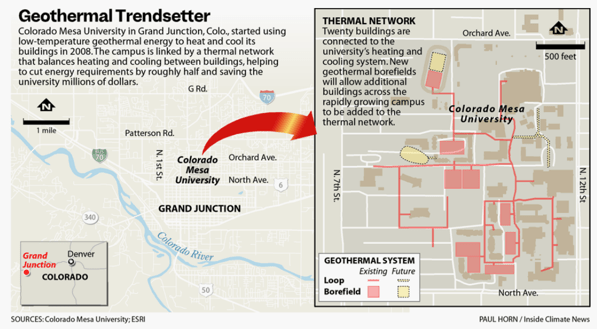
Image credit: https://insideclimatenews.org/news/07022026/colorado-college-geothermal-network/
While the CMU example is extensive and cutting edge, smaller systems have been installed in Utah at Weber State University. The potential for large, integrated community geothermal networks is exciting and worth pursuing.
Commonly Asked Questions about Geothermal Resources
- Isn’t geothermal expensive? Drilling is expensive and is often difficult for existing buildings. Geothermal can be more cost effective for new construction. There are, however, new innovations that enable the heat exchange to occur over a shorter distance to reduce the price and complexity of drilling.
- Does geothermal change the heat resource near wells? This can occur if there are too many wells in too small of an area. For this reason, geothermal is generally not allowed near Yellowstone National Park so as not to impact the geysers. But, generally, thoughtful design and awareness of how the resource is being used can alleviate this. After all, the earth is really big!



 We would like to clarify that Utah Clean Energy is not a solar company. We are a nonprofit organization that advocates for solar and other clean energy technologies, but we do not install or sell solar in any way.