



Have you ever heard the term “Virtual Power Plant” and wondered what they are and how they work? This explainer will provide some background to help understand Virtual Power Plants and how they can benefit the electrical grid and customers.
Virtual Power Plants (VPPs) are defined by the U.S. Department of Energy as “aggregations of distributed energy resources (DERs) such as smart appliances, rooftop solar with batteries, EVs and chargers, and commercial and industrial loads that can balance electricity demand and supply and provide grid services like a traditional power plant.”
The key elements of this definition are that a VPP relies on the aggregation of many resources to benefit the grid and reduce the need for additional power plants. The prevalence of smart appliances, EVs and chargers, batteries, and similar resources, all add up to provide support to our electricity system via VPP programs.
Basics of the Electricity System
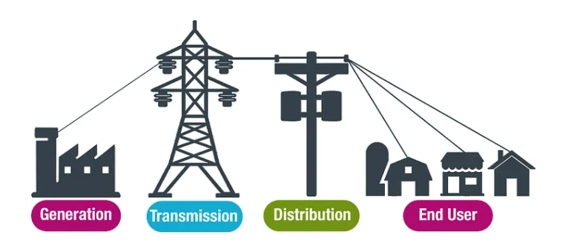
Traditionally, the electricity system was a one-way system where power was generated at a power plant, transmitted over long distances, and distributed to end users. There was no storage on this system, and the generation of electricity had to respond to provide all users with all the power they needed, all of the time. This created a system that had to be built to respond to the highest loads of the year.
Virtual Power Plants Explained
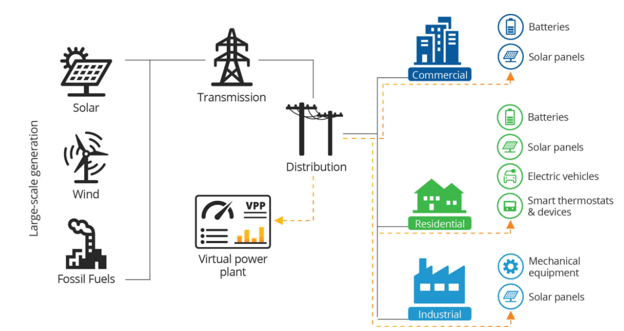
Now, however, with the advent of distributed generation, battery storage, and smart electronics, power is not only consumed by end users, but can also be generated and stored at the end points of the distribution system. This creates a dispatchable resource that can be utilized to meet grid needs and can replace some of the peak generation that was needed in the past.
How, exactly, does this work?
- A utility recognizes a system need – let’s say, a spike in demand.
- The utility calls on distributed resources to help respond to the increase in demand. The utility could turn off an EV charger for a few minutes, turn your thermostat up or down, or pull electricity from your battery so that there is more electricity immediately available while demand is spiking. Typically, these actions are designed to be automated, and for a short duration, so they barely impact the customer. And often the customer can opt out.
So, what’s in it for the customer?
- Generally, there is some sort of incentive for installation and/or participation. These distributed resources have value to the utility and participating customers, as well as ratepayers as a whole, so customers should benefit from participating.
- VPPs can be very cost-effective resources and can reduce the need for the utility to build expensive infrastructure, so they have the potential to limit rate increases for customers.
VPPs as a Pathway to Decarbonization
VPPs can help to maximize potential of renewable energy resources, and promote decarbonization while meeting grid needs. RMI’s Power Shift Report discusses this in detail:
“VPPs can play a key role in meeting emerging challenges on an evolving grid. VPPs provide unique benefits over grid-scale resources: they are rapidly deployable, meet load where it exists, and offer local economic, reliability, and resilience benefits.”
Examples of VPPs in Utah
Rocky Mountain Power (RMP), the utility serving much of Utah, has a couple of programs which are VPPs.
RMP’s Wattsmart Battery Program allows customers to enroll battery storage in the program, either attached to onsite solar or freestanding, in exchange for an incentive. RMP gets draw on the battery to provide resources for both peak grid needs and for voltage control.
Wattsmart Drive is a pilot program that enrolls eligible electric vehicles in a program that can pause your vehicle charging for up to 5 minutes at a time to respond to grid needs. In return, the customer gets an incentive. The interesting thing about this program is that it operates at the vehicle level so if the vehicle is charging anywhere in RMP’s territory, the charging can be paused, using vehicle electronics. This program is still in the pilot phase, but shows a lot of potential. The program achieved 3.93 MW with just over 1,000 vehicles participating in 2025.
VPP Potential in Utah
While RMP has successful VPP programs, there is still room for growth and other value streams that could be captured. For one, smart thermostats can be aggregated and controlled, providing value to the grid. Many existing smart thermostats are already available for this purpose if the utility chooses to use them. Renew Home, for example, is an aggregator that uses smart thermostats as utility scale resources.
Utah Clean Energy is working to understand the value stack of distributed resources to the grid and identify how to optimize the amount of VPP resources on the system to best serve customers and the utility, while maximizing clean energy resources. Fully integrating VPPs into grid planning processes as a reliable resource is necessary to realize the potential of VPPs.



 We would like to clarify that Utah Clean Energy is not a solar company. We are a nonprofit organization that advocates for solar and other clean energy technologies, but we do not install or sell solar in any way.